

What is Parametric Design — and How Does it Become a Clock?
What is Parametric Design — and How Does it Become a Clock?
The architectural software that powers modern towers and bridges is also behind the geometry of our clock collection. Here's what that actually means.
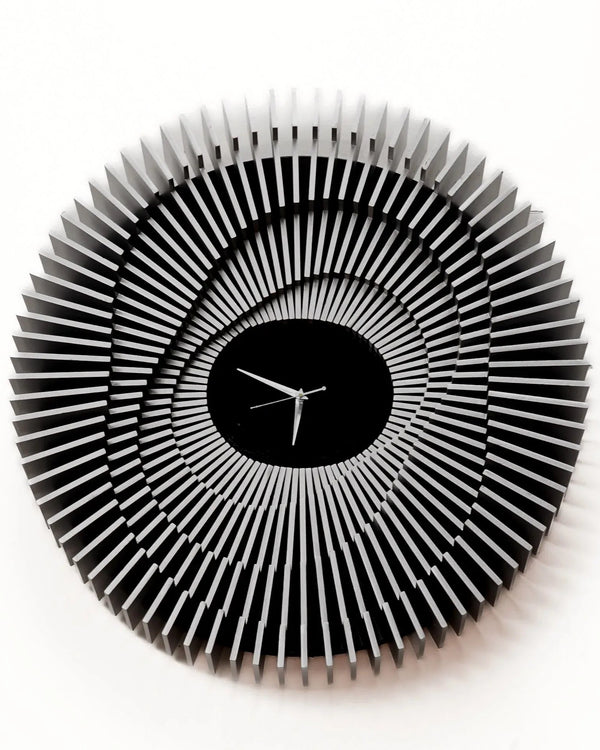
In architecture, parametric design produced the undulating curves of the Beijing National Stadium and the shell-like geometry of the Sydney Opera House. In product design, it's behind bicycle frames that weigh almost nothing and running shoes engineered to the shape of a specific athlete's foot. At velvet & grain, it's behind the face of a clock that no human hand could have drawn.
Parametric design — defined
"A process in which design outcomes are generated by mathematical rules and relationships, rather than drawn directly."
Instead of deciding what a shape looks like and drawing it, a designer sets up a system — a set of rules. The geometry emerges from those rules. Change a parameter (an angle, a frequency, a ratio), and the form changes with it. The result is structures of a complexity and precision that would be impossible to produce by hand.

The same software that generates architectural form now generates our clock geometry.
There are shapes that can't be drawn. They can only be calculated.
Take a clock like our Radial Flux. The design appears to show concentric waves emanating from the centre, each layer slightly offset from the last in a way that creates a continuous spiral motion when you run your eye across it. Describing it is simple enough. But drawing it accurately — maintaining consistent mathematical relationships between all the curves, over twelve separate layers, at the tolerances required for clean laser cutting — is not something a conventional illustration tool handles well.
Parametric modelling software (the same category of tools used to design complex facades in architecture) lets us define those relationships once, as rules. Every subsequent curve, every layer, every spacing gap, is then derived from those rules automatically. Change one parameter — say, the rotational offset between layers — and every element updates simultaneously.
The practical result is a level of geometric precision in the final piece that registers as visual richness. You can't quite count the relationships that make the design work. You just see something that looks impossibly intricate and yet completely resolved.
"We define the relationships as mathematical rules. The form emerges from those rules. Every curve, every layer — derived from the same system."
How a digital model becomes a handcrafted clock.
The design begins in 3D modelling software. A set of mathematical parameters is established — number of layers, angular offsets, frequency of the geometric rhythm, depth of each tier. The software generates the form from these rules. The designer's job at this stage is to find the parameters that produce something beautiful and manufacturable.
Before any material is cut, we model how the piece will cast shadow. We simulate light at different angles — north-facing wall at midday, south-facing wall at 4pm, ambient indoor lighting — and evaluate whether the shadow patterns produced are interesting and varied. A design that looks flat from all angles gets reworked. The shadow must earn its place at each layer.
The vector paths from the model are sent directly to the laser cutter. Each layer is cut from engineered composite to tolerances that are entirely invisible in the final piece — but are what allow the clock mechanism to sit level and the layers to align with precision. After cutting, each layer is hand-finished, lightly sanded, and individually painted before assembly.
The layers are assembled in sequence by hand. This is where the digital model meets the physical world — and where the craft lives. Each layer is positioned, aligned, and fixed. The clock movement is fitted last, and the hands are set. The precision of the parametric design only shows its full quality once the layers sit at their correct depths and the shadows begin to form between them.
Parametric form. Handcrafted in India.
Each clock in our parametric range is a single design — not a variation of a template. The geometry of the Terrace Dial, the Radial Flux, the Eclipse Void, and the Moss Helix are each derived from a distinct set of rules that produces a form unlike the others.
Silent mechanisms. Engineered composite layers. Matte hand-applied finishes. They don't just tell the time. They hold the wall.


Parametric isn't a style. It's a guarantee of precision.
There's a version of this conversation that reduces parametric design to an aesthetic category — geometric, futuristic, cold. That would be a misreading. The parametric method doesn't dictate what something looks like. It dictates how precisely it's constructed.
Our Moss Helix clock, with its botanical spiral layer pattern, doesn't look like our Terrace Dial, with its architectural concentric terracing. Both are parametric. The difference is in the rules that generated them — organic spiral mathematics in one case, architectural section geometry in the other. The shared quality is that neither could be reproduced at the same level of resolution by any other method.
This is relevant to the question of longevity. A piece built from this level of precision doesn't date in the way that trend-driven design does. The Radial Flux will look as considered in fifteen years as it does today — not because it's timeless in some vague sense, but because the geometry is internally resolved. It holds together. It will still be interesting from any angle you look at it a decade from now.
That's the real case for parametric design in a home. Not that it looks a certain way. But that it holds up — mathematically, visually, physically — in ways that less precisely conceived work simply doesn't.


The clock collection
Geometry that holds the wall. Craft that holds up over time.
Every parametric clock is made to order and handcrafted in India.
Explore Clocks Mandala Clocks